We taught Duolingo learners to actually speak.
This is the story of how our team designed the Duolingo Peer Platform, a feature that helps learners cross the gap between a long streak and a real conversation. It started with one uncomfortable truth we kept hearing in interviews: people felt good using the app, but they still froze the moment they had to talk.
A simple assignment with a hard question hiding inside it
Build a real product concept for Duolingo, from customer research all the way to a launch roadmap. We picked the company because everyone on the team already used it. That turned out to be the interesting part.
Our team, the Birdkeepers, was made up of six people who all had a green owl living somewhere on their phone. Some of us had streaks in the hundreds. And yet, when we sat down and talked honestly, almost none of us felt like we could hold a conversation in the language we were supposedly learning.
That gap between how much we used the app and how little we could actually say became the whole project. Instead of inventing a flashy new feature and hoping people wanted it, we decided to start from the frustration we already felt and go find out whether other learners felt it too.
So we set a plan. We would talk to real students, sort their frustrations by hand, score them with a framework so our opinions did not run the show, and only then design something. Everything you read below happened in that order, and this page walks through it the same way we lived it.
The one sentence version
Learners build strong habits on Duolingo but plateau before they can hold a real conversation. We designed a peer to peer speaking feature, guided by AI, to close that gap.
A long streak is not the same thing as fluency
Duolingo is brilliant at building a daily habit. What it does not do, at least not yet, is put you in front of another human and let you stumble through a real exchange until it clicks.
The phrase we heard again and again, in slightly different words every time, was that the app is fun but limited for real conversations. People loved the streaks, the little animations, the sense of showing up. But when a friend asked them to say something in Spanish or French, they went quiet.
The more we listened, the more the problem sorted itself into four honest complaints. None of them are secrets. All of them are the reason so many learners quietly drift away after the beginner stage.
- Habits without depth. A streak proves you opened the app. It does not prove you can order a coffee abroad without freezing.
- Practice that feels like a textbook. Tapping the right tiles is satisfying, but it rarely feels like the messy back and forth of a real chat.
- Real practice is expensive. Human tutors cost real money and need scheduling, which most students do not have to spare.
- Nobody is keeping you accountable. Learning alone is easy to quit, and most people quit right after the honeymoon phase.
This matters because it is not a small niche. Roughly one in three learners drops out after the beginner stage, and the biggest reason they give is the lack of real conversation practice. That is a lot of people who wanted to learn, built a habit, and left anyway.
"Even learners with long streaks admitted they did not feel fluent. That is the gap between consistency and confidence."
A pattern that showed up in almost every interviewWe stopped guessing and started listening
Before we let ourselves design anything, we ran interviews with real students across several universities and programs. The goal was not to confirm what we already believed. It was to find out where we were wrong.
We wrote a discussion guide of open ended questions, careful not to lead people toward the answers we wanted. Each question was tied to a hypothesis about why students learn, what makes them stop, and whether the app was actually building real ability or just a comforting routine.
To keep up with the volume, we used Fireflies to capture transcripts and ChatGPT to help us condense messy notes into themes. We treated the AI as a fast intern, not an oracle, and cleaned up every transcript by hand before we trusted a single quote.
Interviews
Real students, one conversation at a time.
Universities
Different campuses, different pressures.
Programs
From computer science to studio art.
Locations
Spread across the country.

What one interview taught us
One learner, working toward a government recognized French diploma, said something that reframed the whole project. She had tried Duolingo, ignored the notifications, and eventually deleted it. What finally made her serious was paying for structured classes with real people.
Her point was not that Duolingo was bad. It was that habit alone did not make her show up, and it did not give her the explanations, the structure, or the human practice she needed to feel ready. Money and people made her accountable in a way a push notification never could.
"Money is a better motivator than notifications. Once I paid and had real classes, I actually showed up."
Kushi, French learner, interviewed for this studyFour learners we could not stop thinking about
We started with the lazy label of "college students" and quickly threw it out. The real opportunity was a sharper group, learners with strong habits but low confidence, and two subgroups inside it who would try peer practice first.
Alex Ramirez
Mainstream learner · 24 · New York"I want to reconnect with my heritage and actually use Spanish when I travel."
A marketing professional who squeezes five minute lessons into his morning coffee and evening commute. He needs practice that is affordable, adaptive, and easy to keep up with a busy life. The free tier is what got him in the door.
Emily Chen
International grad student · 24 · Los Angeles"Language is the first barrier to making friends and working in this country."
A computer science masters student from China. She reads and writes English confidently, but seminars, career fairs, and casual small talk make her anxious. She wants practice that fits between coursework and job applications, and that builds real speaking confidence.
Jake Miller
Sophomore · 20 · New York University"I want to turn my commute into real learning instead of doomscrolling."
Diagnosed with ADHD and easily pulled away by short form video. He starts lessons on the subway and gets interrupted constantly. He needs short, novel tasks that match his attention span, plus real accountability so a broken streak does not end the whole thing.
Maya Thompson
Comparative literature · 19 · On campus"I learn languages for K-pop lyrics, anime, and Spanish films."
A fandom driven learner who finds generic vocabulary boring. She wants niche words tied to the culture she loves, and she wants to share progress with her online community. For her, learning is part of her identity, not a chore.
Once we had these four in front of us, the target got obvious. We narrowed the launch to university students who already had the habit but not the confidence, with international and neurodiverse learners as the first people we would win over.
From twelve complaints down to two that mattered most
Every learner had opinions, and every opinion felt urgent in the moment. To keep our own bias out of it, we scored all twelve pain points with the RICE framework, then filtered them again with MoSCoW.
RICE forces you to be honest. For each pain point we asked how many people it reaches, how much impact solving it would have, how confident we were, and how much effort it would take. The math does not care about your favorite idea, which is exactly the point.
| Pain point | Reach | Impact | Confidence | Effort | RICE |
|---|---|---|---|---|---|
| Shallow learning impact | 5 | 5 | 4 | 4 | 25 |
| Weak conversational practice | 4 | 5 | 4 | 4 | 20 |
| Ad heavy free tier | 5 | 3 | 5 | 3 | 25 |
| Notification fatigue | 5 | 2 | 4 | 2 | 20 |
| Gamification pressure | 4 | 2 | 4 | 2 | 16 |
| High subscription cost | 4 | 3 | 4 | 4 | 12 |
| Limited advanced learning support | 3 | 4 | 4 | 4 | 12 |
| Unclear long term value | 4 | 4 | 3 | 4 | 12 |
| Exercise redundancy | 4 | 2 | 4 | 3 | 11 |
| Minimal native speaker influence | 3 | 4 | 3 | 4 | 9 |
| Lack of formal recognition | 2 | 3 | 3 | 5 | 7 |
| Unnecessary social features | 3 | 1 | 4 | 2 | 6 |
A few things scored high on raw RICE, including the ad heavy free tier. But when we ran everything through MoSCoW and weighed real learner value against business impact, two pain points rose to the top as genuine must haves. They also happened to be two sides of the same coin.
Must have
- Shallow learning impact
- Weak conversational practice
Should have
- Ad heavy free tier
- Notification fatigue
Could have
- Gamification pressure
- High subscription cost
Won't have yet
- Unnecessary social features
- Formal recognition
The verdict
Shallow learning impact and weak conversational practice. Solve real speaking, and you quietly solve the depth problem too.
The Duolingo Peer Platform
A university focused space where learners join short, guided speaking events with real peers, and an AI coach rides along to keep the conversation flowing and hand back honest feedback at the end.
We considered three directions. One leaned into contextual conversation practice. Another focused on student friendly pricing and certificates. A third built calmer, ADHD friendly engagement. All three were good, but only one hit both of our must have pain points at once, and hit them in a way no competitor was doing.
So we committed to conversational and contextual learning, delivered as a peer platform. The magic is the blend. Real humans bring the unpredictability and warmth of an actual conversation. The AI brings structure, gentle prompts when things stall, and feedback that would normally cost a tutor.
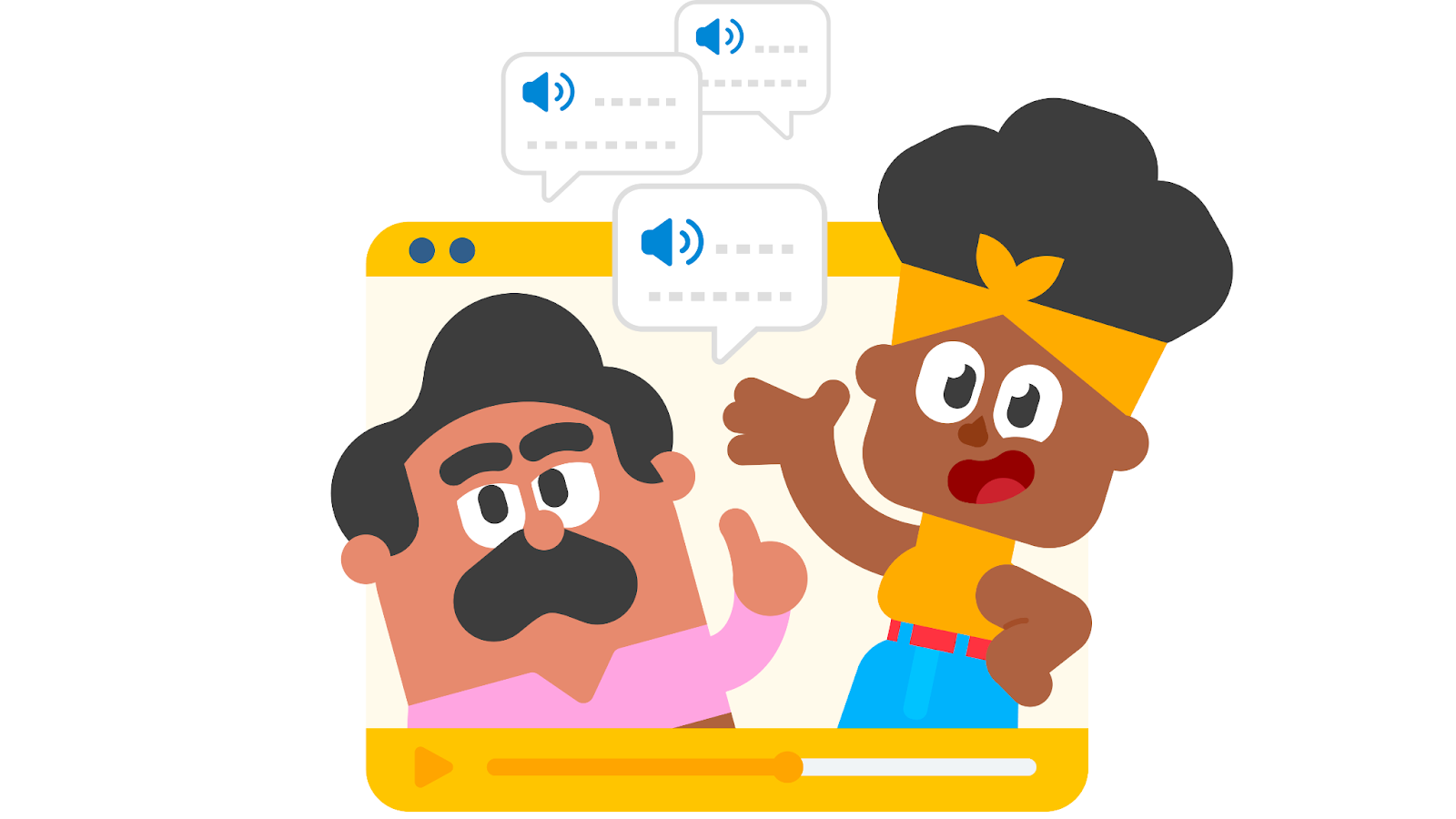
Peer matching
Learners are paired by proficiency, goals, and context, whether that is studying abroad or prepping for a career fair, for quick sessions of ten to twenty minutes.
Fifteen minute guided sessions
An AI guide sets the scene and offers prompts so the conversation never dies, from ordering food to a mock interview to campus small talk.
Real time AI feedback
Instant, private notes on pronunciation, fluency, and clarity, with a clean summary the moment the session ends.
Just enough gamification
Streaks, points, and conversation milestones to keep learners coming back, without the pressure that made people resent the old notifications.
The core loop
Browse events, join one, practice with a peer, receive AI feedback, then come back for the next. Simple enough to build as an MVP, sticky enough to become a habit.
The app, running right here
Talking about a speaking feature only goes so far. So here is a working prototype inside a phone. Tap through the flow, or use the steps on the left, and watch a learner go from browsing events to getting real feedback.
Follow the core loop
This is the exact journey we designed for. Each screen is interactive, so click around the same way a learner would on a Tuesday night before a trip.
This concept was also built as a separate clickable prototype during the course. You can open that version too.
Open the v0 prototypeCafé small talk
Order a drink, make small talk, react naturally
Try asking Sofía what she usually orders and why. Then react to her answer.
Nice work
Here is your private session summary
Why this is worth building, not just nice to have
A good feature still has to earn its place. The Peer Platform turns Duolingo from a beginner friendly app into a full learning ecosystem, and it feeds the same flywheel that already makes the company work.
Duolingo already runs on two loops. More learners create more data, which sharpens the product, which brings in more learners. More engagement drives more paid subscribers, which funds more investment. Speaking practice pours fuel on both, because it is exactly the kind of high value habit that keeps people around and nudges them toward Super and Max.
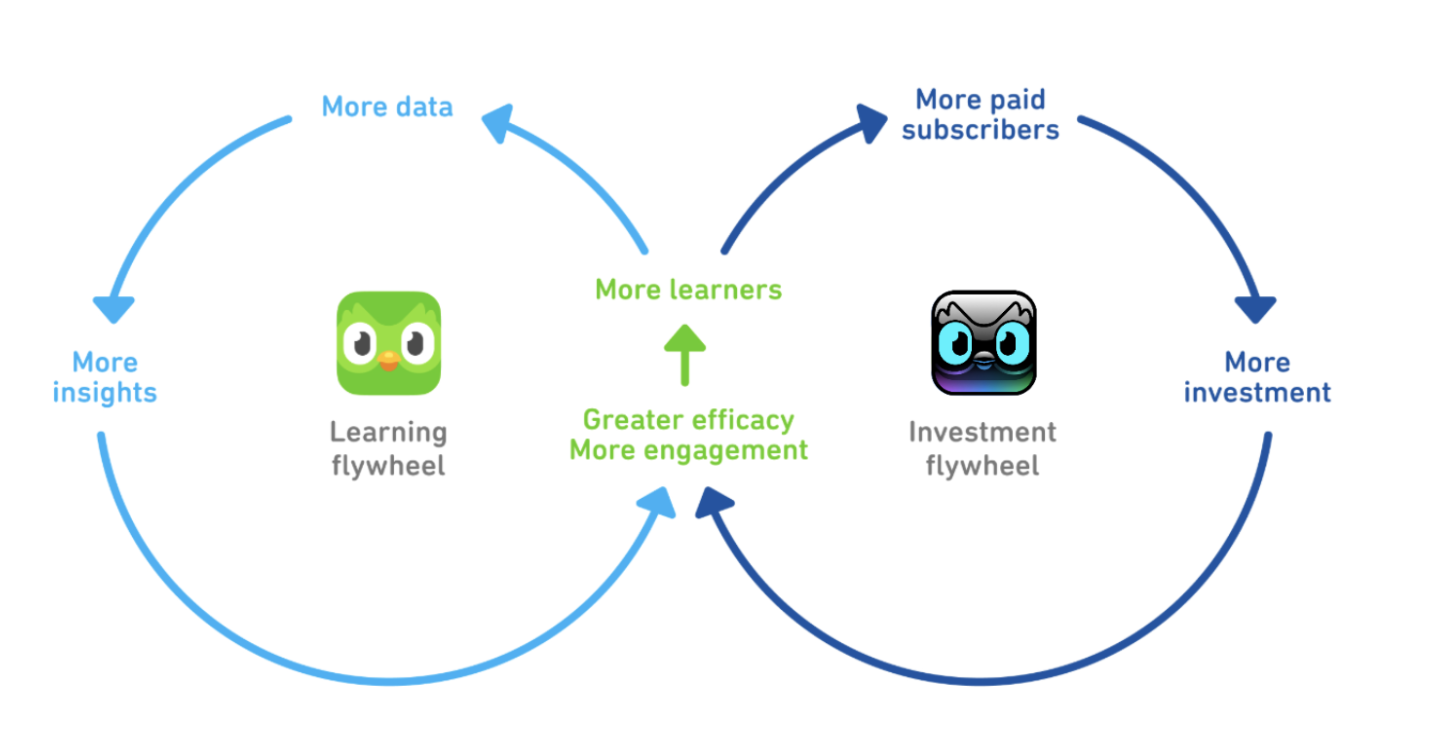
The market backs it up. Language learning is on its way from roughly 21 billion dollars to 44 billion by 2030, pushed by AI and community driven learning. Here is how we sized our slice of it.
Language learners worldwide
Mobile first learners across the major apps
College aged Duolingo users, starting in the US
North star metric
Weekly speaking minutes per learner. It is the cleanest signal that the feature is working, and it maps directly to retention and upgrades.
How it pays off
Free learners get limited sessions and basic feedback. Super and Max unlock premium matching, themed events, and richer AI coaching, which lifts revenue per user.
Everyone solves part of this. Nobody solves all of it
We looked hard at who else was helping people speak. Each option nails one piece and drops another. The gap in the middle is exactly where the Peer Platform lives.


"We combine cultural authenticity, community accountability, and structured feedback at scale. That mix is what nobody else offers."
Our competitive thesis, in one lineCrawl, then walk, then run
We did not try to ship everything at once. The plan proves value cheaply first, grows engagement second, and only scales to market leadership once the hard parts, like safety and privacy, are solid.
- Short 10 to 15 minute events for daily scenarios
- AI feedback on pronunciation and fluency basics
- English to Spanish, US university students
- Longer 20 to 30 minute events across contexts
- Richer, personalized feedback and tips
- More language pairs, working professionals
- Personalized event recommendations
- In session AI guidance and structured prompts
- All languages, full US base over 16
The work held up
We delivered a full product plan, a clickable prototype, and a final readout. The feedback we got back told us the story hung together, from the research all the way to the roadmap.
Average across the written plan and the final presentation
"Nice alignment from market to users to MVP. Great RICE analysis in detail. Small changes, high impact, with great slide design and a strong Crawl, Walk, Run roadmap."Professor feedback, Product Management
"Loved the team photo on the cover, very creative. Really enjoyed the live demo at the end."Teaching team
The lessons that outlasted the grade
Some of these are about product. Some are about how a team of six actually gets to a decision. All of them stuck with me.
Community is a catalyst
Social practice made gamification and retention stronger. It was never an add on, it was the point.
Prioritization is the real skill
Prioritization is not just for features. It is how a team manages its own flood of ideas without stalling.
Watch the small players
Studying scrappy startups like HelloTalk early surfaced opportunities the big names never showed us.
Sequence the MVP
Every feature felt essential. Learning to ship by user value, in order, was harder and more useful than any single idea.
If I ran this project again, I would spend more time sharpening our research objectives before touching any tools, and I would set milestone tracking earlier so the last week did not carry so much weight. But I would keep the core instinct that made it work. We started from a frustration we genuinely felt, we let real learners correct us, and we let a framework, not the loudest voice, pick the winner.
Want to see it move?
Play with the prototype above, or open the separate clickable version we built during the course.
Open the v0 prototype